
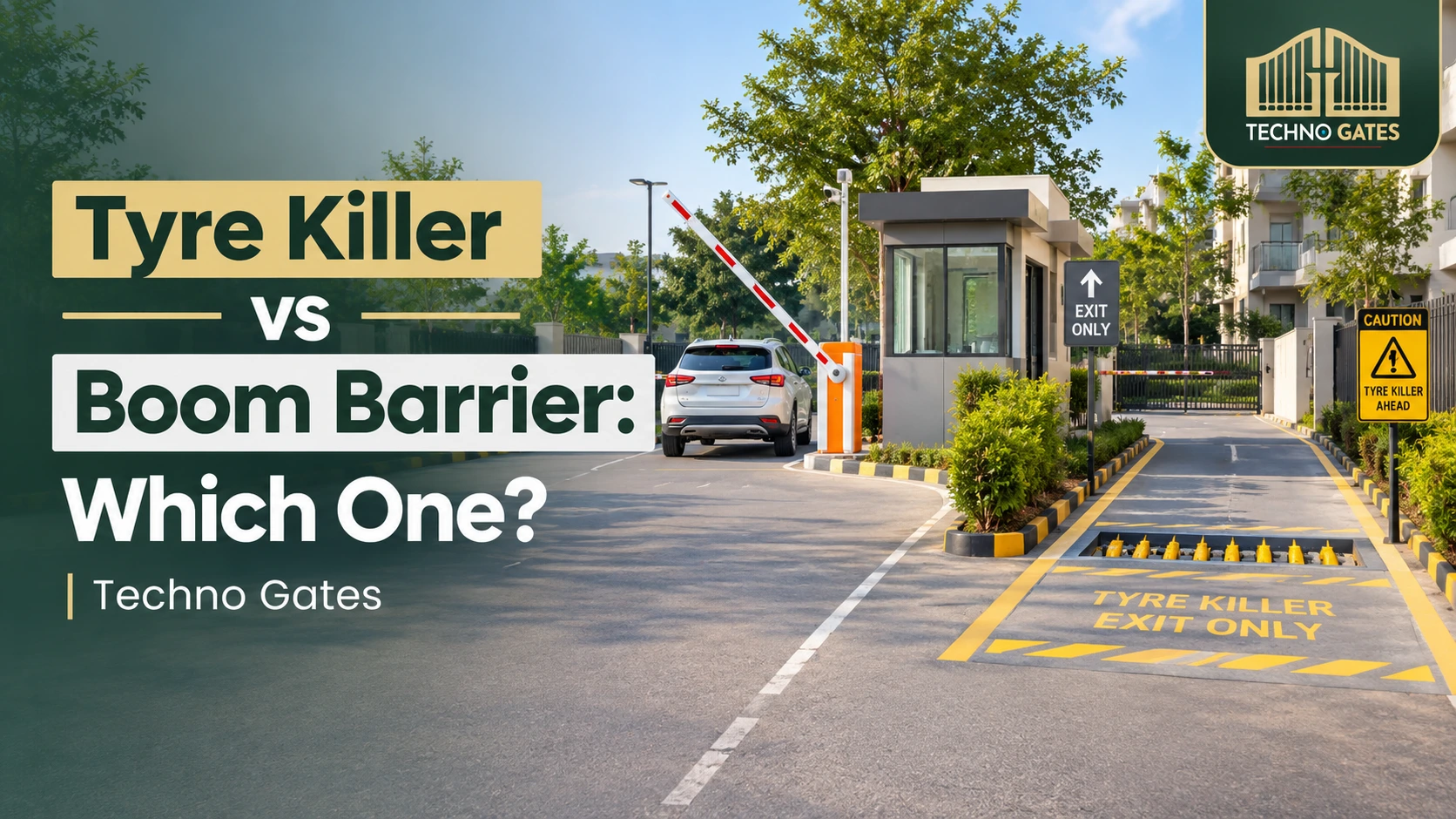
You run a housing society, an office parking lot or a factory, and you want better control over the vehicles coming in and going out. Someone suggests a boom barrier. Someone else says a tyre killer is stronger. Both sound useful, but they do very different jobs, and picking the wrong one can waste money or even cause trouble.
In this guide, Techno Gates explains the tyre killer vs boom barrier question in plain words: how each one works, where it fits, what the risks are, and which one you should install for your place.
The Quick Answer
- Boom barrier: controls who enters and leaves. It is the right choice for most societies, offices, hospitals, malls and parking lots.
- Tyre killer: stops vehicles from moving in the wrong direction by damaging their tyres. It suits one-way lanes and high-security sites, but it comes with safety and liability risks.
- Best of both: many sites use a boom barrier for access control and add a tyre killer only on an exit-only lane, with clear warning signs.
- Need protection against forced ramming? Neither of the two is built for that. Ask about bollards or road blockers.
What Is a Boom Barrier?
A boom barrier is an automatic arm that lifts and lowers across a driveway. A motor and a control board move the arm, and the arm opens when it gets a signal: a remote, an RFID card or tag, a ticket from a machine, an intercom call from the security guard, or number-plate recognition.
Boom arms usually come in different lengths, roughly from 3 to 6 metres, so they can suit a narrow lane or a wide entry.
Where it is used: housing societies, offices, hospitals, malls, parking lots, factories, schools and toll-style entry points.
What is good about it
- Controls and records who comes in and goes out
- Works with RFID, remote, tickets, intercom and other access systems
- Safe for pedestrians, two-wheelers and mixed traffic
- The arm is made to break away or stop if something is in the way, so it does not damage vehicles
- Looks neat and is easy to understand for drivers
What to watch out for
- It is access control, not a crash barrier. A vehicle that is pushed through can snap the arm
- It needs power, so a backup or a manual release is important
- Wrong-way entry on a lane is not physically prevented
What Is a Tyre Killer?
A tyre killer, also called a road spike barrier, is a strip or plate fitted with strong angled spikes across a lane. It works as a one-way control. A vehicle driving in the allowed direction passes over it, while a vehicle driving the wrong way gets its tyres punctured.
There are two common types:
- Fixed (non-retractable): the spikes fold down when a vehicle goes in the permitted direction and stay up against a vehicle going the other way
- Automatic (retractable): the spikes are raised or lowered by a motor or hydraulic system, so the lane can be blocked or opened as needed, often together with a boom barrier or gate
Where it is used: exit-only lanes of parking lots, factory and warehouse exits, high-security compounds and similar controlled private premises.
What is good about it
- Strongly discourages wrong-way entry on an exit lane
- Needs no one to watch the lane all the time
- A visible deterrent for security-sensitive places
What to watch out for
- It damages tyres, which can bring complaints and liability if a visitor, delivery driver or emergency vehicle drives over it by mistake
- A vehicle with burst tyres can lose control, which is a real safety concern
- It is risky wherever there are pedestrians, children, two-wheelers or mixed traffic
- It does not stop a vehicle right away. It damages tyres after the vehicle has gone over
- Dust, water and debris can affect the moving parts, so it needs regular checks
- Rules and society norms differ. Use it only on private premises, with clear signs, and with the written approval of your society or management. If in doubt, check with your local authority
Tyre Killer vs Boom Barrier: Side-by-Side Comparison
|
Factor |
Boom Barrier |
Tyre Killer |
|---|---|---|
|
Main job |
Controls who enters and exits |
Stops wrong-way driving |
|
How it works |
Arm that lifts and lowers |
Spikes that puncture tyres on wrong-way travel |
|
Works with RFID, remote, tickets |
Yes |
Only with an automatic type linked to a controller |
|
Safe for mixed traffic |
Yes |
No |
|
Risk of vehicle damage |
Very low |
High if driven over wrongly |
|
Stops forced ramming |
No |
No |
|
Needs power |
Yes |
Only the automatic type |
|
Best for |
Societies, offices, malls, parking lots |
Exit-only lanes, high-security sites |
|
Relative cost |
Medium |
Varies with type and lane width |
Which One Should You Install?
Housing society: a boom barrier with RFID or remote at the main gate is the right start. If wrong-way entry through the exit lane is a real problem, add a tyre killer on that exit-only lane with large warning signs.
Office or commercial parking: a boom barrier with ticket or RFID access. A tyre killer is rarely needed.
Factory or warehouse: a boom barrier at the gate with a security cabin. For an exit-only lane, a tyre killer can help. For high-risk sites, talk about bollards or road blockers.
Hospital, school or any place with pedestrians and mixed traffic: go with a boom barrier. Avoid a tyre killer.
Government or very sensitive locations: these usually need certified high-security barriers designed with a security consultant.
What About the Cost?
We are not printing a price here, because it would be out of date soon and it would not match your site anyway. These are the things that decide the cost:
- Boom barrier: arm length, motor type and speed, access control (RFID, tickets, ANPR), civil work and power backup
- Tyre killer: lane width, fixed or automatic type, how much road cutting and foundation is needed, and the hydraulics or motor for automatic models
Ask for a written quote that lists each of these items so that you can compare offers properly.
Five Mistakes to Avoid
- Choosing a tyre killer for a lane that also has pedestrians or two-wheelers
- Skipping warning signs. Signs are not optional with spikes
- Thinking a boom barrier is a security barrier. It controls access, it does not stop a ramming vehicle
- Forgetting power backup and a manual release for the boom barrier
- Installing without a site visit. Lane width, slope, traffic flow and the guard cabin position all matter
Why Talk to Techno Gates
Techno Gates is an Automatic Gate Manufacturer in Faridabad. We build and automate sliding, swing and cantilever gates, and we set up access control for homes, societies, offices and factories. Because we look at your whole entrance, not just one product, we can tell you honestly whether you need a boom barrier, a tyre killer, both, or something else.
You can read more about how we work on our fabrication company in Faridabad page, or see what we do on the Techno Gates.
Planning to control vehicle entry at your society, office or factory? Book a free site visit or call +91-9711813450. We'll look at your lane and suggest what actually fits.