
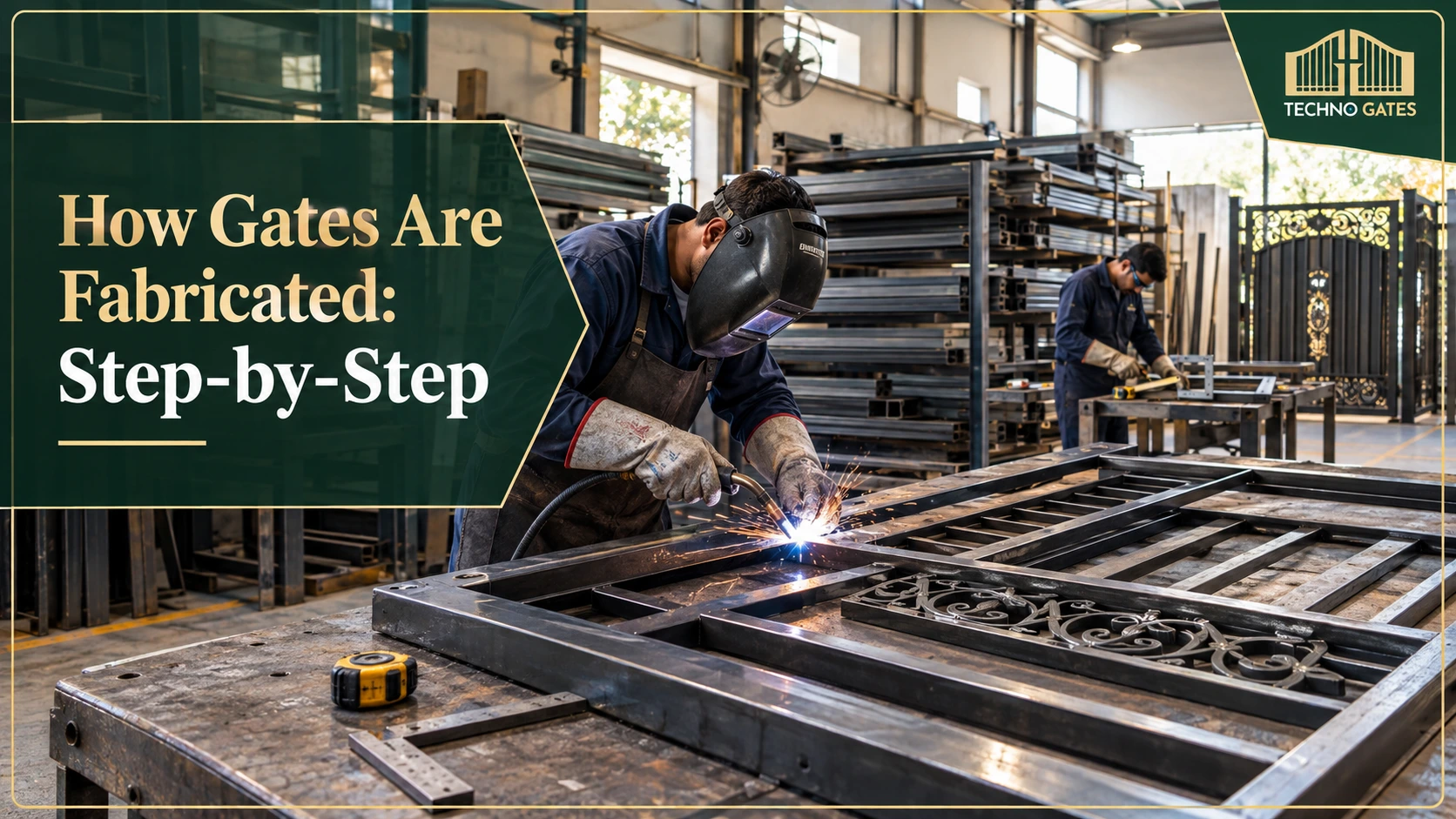
Most people see a gate only when it is finished and standing at the entrance. They never see the weeks of work behind it: the measuring, the cutting, the welding, the coating and the careful fitting. If you are planning a new gate, knowing how a gate is fabricated helps you judge quotes, ask better questions and avoid shortcuts.
In this guide, Techno Gates walks you through the whole process in plain words, the same way we do it in our Faridabad workshop. You will also learn what decides steel gate rates in Faridabad, so you can compare quotes properly.
The Process at a Glance
- Site visit and measurement
- Design and drawing
- Material selection and cutting
- Fabrication: welding or joining
- Surface preparation and finishing
- Fitting the hardware
- Installing the automation (for automatic gates)
- Installation at your site
- Testing and handover
Let's go through each step.
Step 1: Site Visit and Measurement
Every good gate starts at your opening, not in the workshop. A fabricator visits the site and measures the width and height of the opening, checks whether the pillars are straight, looks at the ground level and slope, and notes how much space is available for a sliding gate to move or a swing gate to open.
This step decides everything that follows. A gate made from guesses over the phone almost never fits properly. That is why a trusted fabrication company in Faridabad will always want to see the site first. At Techno Gates, the site visit is free.
Step 2: Design and Drawing
Next comes the design. This is where you decide the type (sliding, swing, cantilever or fixed), the look (modern slats, ornamental jali, glass panels) and the material. A good fabricator explains the options in simple words and then makes a drawing so you can see what you are paying for before any metal is cut.
If you are still choosing a material, our guides on aluminium vs steel gates and MS vs SS vs aluminium gates will help.
Step 3: Material Selection and Cutting
This is the stage where quality is won or lost, because the material decides how long the gate lasts.
- For steel gates, the fabricator picks MS (mild steel) or SS (stainless steel) pipes, square tubes, flats and plates of the right thickness. Thicker sections cost more and last longer. Cheap quotes often use thin pipes.
- For aluminium gates, the sections are extruded profiles. Section thickness and quality again make the difference between a gate that stays straight and one that sags.
The material is then cut to length with the correct angles, so the pieces fit together without gaps.
Step 4: Fabrication: Welding and Joining
Now the pieces become a gate. The frame is built first, laid flat on a jig or a level table so it stays square. Then the inner bars, jali work or panels are added.
- MS is welded, and welds are ground smooth so there are no sharp bumps.
- SS needs careful welding and polishing so the surface keeps its look and its rust resistance.
- Aluminium is joined by welding or by corner connectors, depending on the section and design. Glass or panels are fitted into the frame.
A gate that is welded on an uneven floor will twist, so a flat jig and a square check at every stage matter more than most people realise.
Step 5: Surface Preparation and Finishing
This is the step many cheap fabricators rush, and it is the reason some gates start rusting in two monsoons.
For MS gates, the surface is cleaned of rust and grease and then given a rust-proof primer. After that comes the finish: two coats of good enamel paint, or a powder coat. For extra protection, galvanising can be done before painting.
For powder coating, the clean metal is sprayed with coloured powder and then baked in an oven, which makes a hard, even finish that resists chipping better than ordinary paint.
For aluminium gates, the finish is usually powder coating or anodising, in colours such as black, grey, bronze or a wood finish.
A simple way to remember it: the finish is the gate's raincoat. Skipping a step here costs you far more than it saves.
Step 6: Fitting the Hardware
Hinges, rollers, tracks, locks, latches and handles are fitted next. These small parts decide how smoothly the gate moves and how safe it is. A gate with a strong frame but weak hinges will still sag, and a gate with a good lock but poor fixing can still be forced.
This is also the point where a swing gate is balanced and a sliding gate is checked for smooth movement on its rollers.
Step 7: Installing the Automation (for Automatic Gates)
If you want an automatic gate, the motor, rack or arm, sensors, remote receiver and control board are fitted. The size of the motor depends on the weight of the gate, which is why the material and size must be decided first.
As an Automatic Gate Manufacturer in Faridabad, we always fit the motor to the gate, never the gate to a random motor. Safety sensors and manual release are checked at this stage too, so the gate stops if something is in its way and can still be opened during a power cut.
Step 8: Installation at Your Site
The finished gate is brought to your site and fitted. The team checks the pillars, fixes the hinges or track, aligns the gate so it is level and plumb, and makes sure the gap at the bottom and sides is even. For sliding gates, the track foundation is set carefully because everything depends on it.
If pillars need repair or a foundation is required, it is better to discuss this at the site visit than to find out on installation day.
Step 9: Testing and Handover
Before the job is closed, the gate is opened and closed many times to check smooth movement, locking, sensors and the remote. You are shown how to use the manual release and how to clean and look after the gate. A good fabricator also tells you how to reach them if something needs attention later.
How Long Does the Whole Process Take?
Timelines depend on the size and design. As a rough guide, standard home gates are usually completed within 3 to 7 days after the design is approved, while larger or custom projects can take 2 to 4 weeks. Painting, powder coating and delivery of motors can affect the schedule. You should get a clear timeline after the site inspection.
What Decides Steel Gate Rates in Faridabad?
This is the question we get most, and the honest answer is that there is no single rate. Steel gate rates in Faridabad depend on several things, and steel prices also move from month to month, so any number printed in a blog can be out of date within weeks. What matters is knowing what you are paying for.
|
What affects the price |
Why it matters |
|---|---|
|
Material: MS, SS or aluminium |
SS and aluminium usually cost more than MS |
|
Section thickness and weight |
Thicker pipes and tubes use more metal and last longer |
|
Gate size |
A bigger opening needs more material and a stronger frame |
|
Design |
Heavy jali and custom shapes take more labour than a plain frame |
|
Finish |
Basic paint, powder coating and galvanising cost differently |
|
Hardware |
Better hinges, rollers and locks cost more but last longer |
|
Automation |
Motor size, sensors, remote and access control add to the cost |
|
Installation work |
Pillar repair, track foundation and transport can add to the cost |
Some fabricators quote by weight, others by area (per square foot). Either way, the number only means something when the material, thickness and finish are written next to it.
Red flags in a very cheap quote: no section thickness mentioned, no primer or coating details, no SS grade written, and no mention of hardware or installation. If a quote is far below the others, check what has been left out.
How to Choose a Fabrication Company in Faridabad
Whether you want steel or aluminium, look for these signs before you pay an advance:
- A site visit before the quote, not just a phone estimate
- A written quote that lists material, thickness, finish, hardware and installation
- Photos of real work, ideally with a visit to the workshop
- Clear timelines and a person you can call
- After-sales support for repairs and adjustments
If you are comparing aluminium fabricators in Faridabad, also ask which sections they use and what kind of finish and warranty they give, because quality varies a lot between suppliers.
Why Talk to Techno Gates
Techno Gates is a Faridabad-based fabrication company working with both steel and aluminium. We make custom steel gates, aluminium gates, glass gates, and sliding, swing and cantilever gates, with automation and access control if you want it. Everything is done from site visit to installation by our own team, so you deal with one group of people from start to finish.
We will tell you honestly which material and design suit your gate, and we give you a written quote you can compare.
Planning a new gate? Book a free site visit or call +91-9711813450. Tell us your opening size and what you have in mind, and we'll take it from there.
A good gate is made in the details: accurate measurements, the right thickness of material, clean welds, proper surface preparation and careful fitting. When you understand these steps, you can read any quote with confidence and spot the shortcuts that cost you later. If you want a team that explains each step and shows its work, Techno Gates is happy to help.